Finding petite wedding guest dresses that feel made for you, rather than simply shortened versions of a standard dress, can transform how you feel at a wedding. A dress that respects a smaller frame, with a waist, hem and neckline placed where they belong, looks polished without effort and lets you move, sit, dance and enjoy the day in comfort. This guide explains how to choose lengths, silhouettes and proportions that flatter a petite frame, and how to style them for every season and venue.
Petite sizing is about proportion, not only about height. A petite dress is usually cut with a shorter bodice, a higher waist placement, narrower shoulders and a shorter overall length, so the design sits in balance on a smaller frame. A standard dress taken up at the hem alone can leave the waist too low, the neckline too wide and the sleeves too long, which is why starting with a petite cut, or choosing a style that can be altered thoughtfully, makes such a difference.
What to Look for in a Petite Wedding Guest Dress
Start with fit through the shoulders and bodice, because those areas are hardest to alter well. Shoulder seams should sit on the shoulder point, not slip down the arm, and the bodice should follow your shape without gaping at the neckline or pulling across the bust. A dress that fits well here will look considered even before you add shoes, jewellery or a wrap.
Next, check where the waist falls. A defined waist, whether from a seam, a wrap tie, a belt or clever seaming, creates shape and stops a dress from swamping a petite frame. Empire lines, which sit just under the bust, can also work beautifully, especially in flowing fabrics, because they lengthen the lower body while keeping the upper body neat. Avoid a waistline that sits on the hips unless the dress is deliberately designed that way, as it can shorten the legs visually.
Finally, think about the whole day, not only the photographs. You will sit through a ceremony, stand for photographs, walk between venues, eat, and hopefully dance. A dress that needs constant adjusting, slips off the shoulder or restricts your stride will distract you all day. Sit down in it, walk in it and raise your arms before you commit, just as you would with any occasion dress.
Lengths That Work Best for Petite Frames
Length is the single most powerful tool for petite styling, and the right choice depends on the formality of the wedding as much as on your frame. Knee-length dresses are a reliable, versatile choice for daytime and semi-formal weddings. They show the leg, keep the outfit feeling light, and pair easily with heels, block heels or elegant flats. A hem that finishes just above or on the knee usually looks neat, while a hem that cuts across the widest part of the calf can shorten the leg, so try the dress with your chosen shoes before deciding.
Midi dresses, which fall between the knee and the ankle, can be wonderfully elegant for petite guests when the proportions are right. Look for a midi that finishes at the slimmest part of the lower leg, with a defined waist and a skirt that moves rather than hangs heavily. A midi with a slit, an asymmetric hem or a soft A-line shape keeps the line long and avoids the boxy effect that a straight, heavy midi can create on a smaller frame.
Long dresses are not off limits for petite guests, but they need more care. A floor-length gown in a flowing fabric, with a raised waist or a column shape, can look strikingly elegant, especially for evening weddings. The key is to avoid excess fabric pooling at the hem and to choose a silhouette that creates one continuous line rather than breaking the body into sections. For more on how length, drape and silhouette work together, our guide to the black maxi gown explains the same principles in detail, and they apply just as well to wedding guest dresses in any colour.

Silhouettes That Flatter a Petite Frame
An A-line silhouette, fitted through the bodice and flaring gently from the waist, is one of the most dependable choices for petite wedding guests. It defines the waist, skims the hips and gives movement without adding bulk, and it suits a wide range of fabrics from chiffon to crepe. A-line dresses also adapt well to different venues, feeling relaxed in a garden and refined in a formal room.
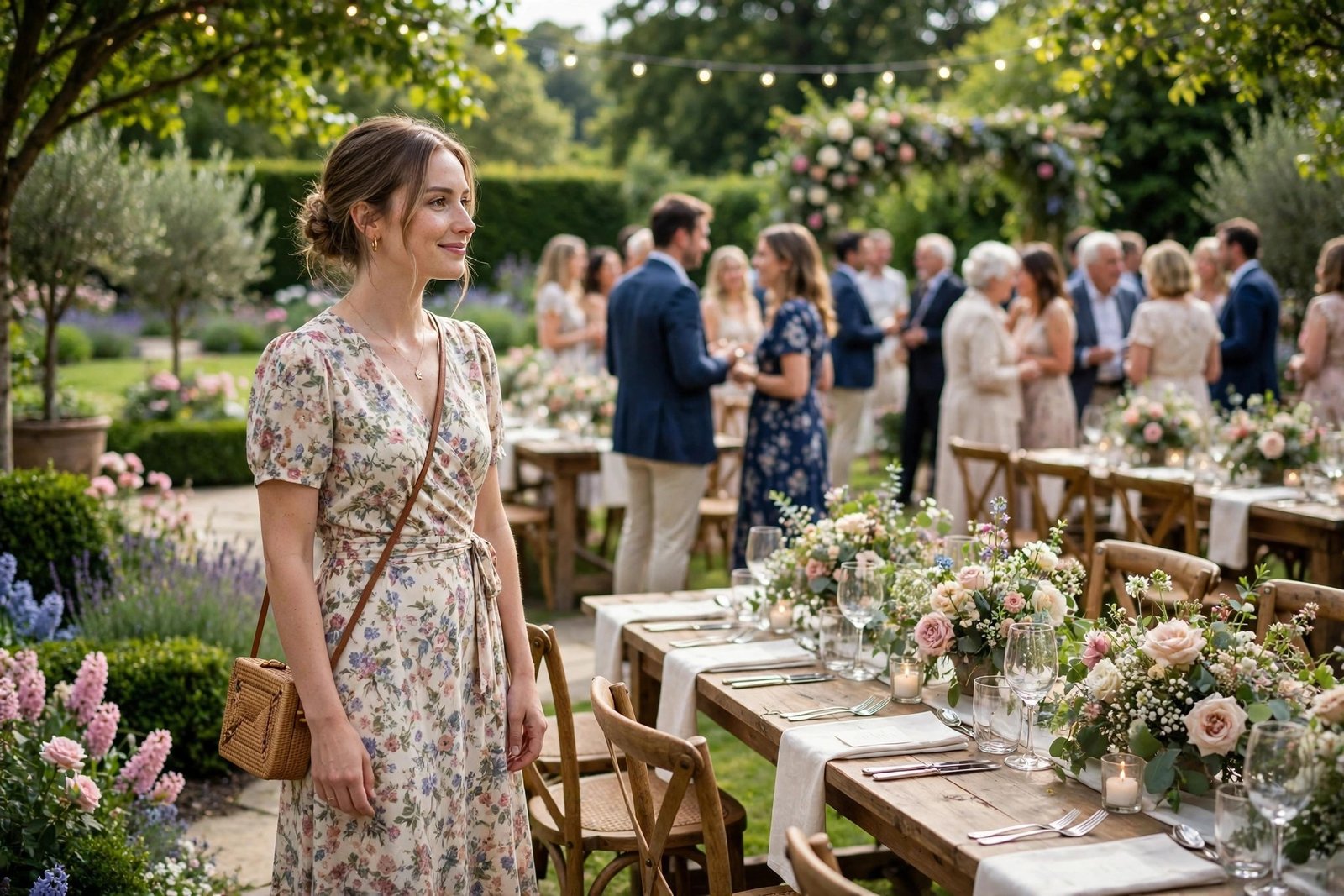
Wrap dresses deserve a special mention for petite frames. The wrap tie lets you place the waist exactly where it suits you, the V-neckline lengthens the neck, and the skirt falls in soft folds that flatter without overwhelming. Wrap styles also adjust comfortably across the bust, which makes them a forgiving choice if you are between sizes or want a dress you can wear again for other occasions.
Column and sheath dresses offer a sleek, modern alternative, particularly in crepe or satin. They create a long, uninterrupted line, which is flattering on a petite frame, provided the dress is not so straight that it restricts movement. Look for a column dress with a little stretch, a neat slit for walking, and a neckline that draws the eye upwards. Fit-and-flare dresses, which hug the bodice and flare from the waist, give a similar sense of shape with more freedom for dancing.
Styles to approach with care include very voluminous ballgown skirts, heavy tiered skirts and oversized sleeves, all of which can overwhelm a smaller frame. That does not mean avoiding drama altogether. A single statement detail, such as a beautiful sleeve, an interesting neckline or a flowing skirt, usually looks more polished than several competing details at once.
Proportions, Necklines and Details That Make a Difference
Small proportion choices add up to a big difference on a petite frame. A V-neckline or a sweetheart neckline lengthens the neck and draws attention upwards, while a high neckline can look striking if it is balanced with an updo or a neat hairstyle that keeps the neck visible. Scoop and square necklines sit between the two, offering a soft, classic frame for the face.
Sleeves should be in scale with the dress and with you. Cap sleeves and short sleeves suit warm weather and keep the arms feeling free, while three-quarter sleeves are a flattering, versatile choice that covers the upper arm without adding weight. Long sleeves in sheer fabric or lace can look elegant for cooler weddings, but very wide or heavily embellished sleeves may dominate a petite frame, so keep the sleeve detail in proportion to the rest of the dress.
Prints and patterns also affect proportion. Smaller, well-spaced prints tend to sit more harmoniously on a petite frame than very large, bold motifs, though a single large floral or an abstract print can work beautifully if the dress itself is simply cut. Vertical details, such as a long line of buttons, a centre seam or a flowing scarf-like drape, help to lengthen the eye, while strong horizontal breaks at the waist or hem should be used deliberately, for example with a belt that defines the waist.
Colour choice is personal, but a few guidelines help. A single colour from neckline to hem creates a long, unified line, which is naturally flattering. Soft pastels suit spring and summer weddings, deeper tones suit autumn and winter, and jewel tones work across seasons. If you love a bold colour, let it be the star and keep accessories calm, so the dress, not the styling, carries the look.
Seasonal Styling for Petite Wedding Guests
Spring weddings call for lighter fabrics and fresh colours. Chiffon, georgette and light crepe move beautifully in a spring breeze and suit garden and outdoor venues, while a knee-length or midi dress in a soft floral or pastel shade feels seasonally right. A light wrap or a cropped jacket is worth packing for the evening, when outdoor venues cool down.
Summer weddings reward breathable fabrics, open shoes and minimal layering. A sleeveless or short-sleeved dress in a light fabric will keep you comfortable through a long afternoon, and a midi length offers a little more coverage than a short dress without adding warmth. Keep accessories light too, with delicate jewellery and a small bag, so the outfit feels airy rather than weighed down.
Autumn weddings welcome richer colours, heavier fabrics and thoughtful layering. Crepe, satin and velvet bring warmth and depth, and a midi dress with three-quarter sleeves pairs naturally with closed shoes and a tailored wrap. Deeper floral prints and jewel tones suit the season, and a wrap or shawl in a complementary tone adds both warmth and polish for evening photographs.
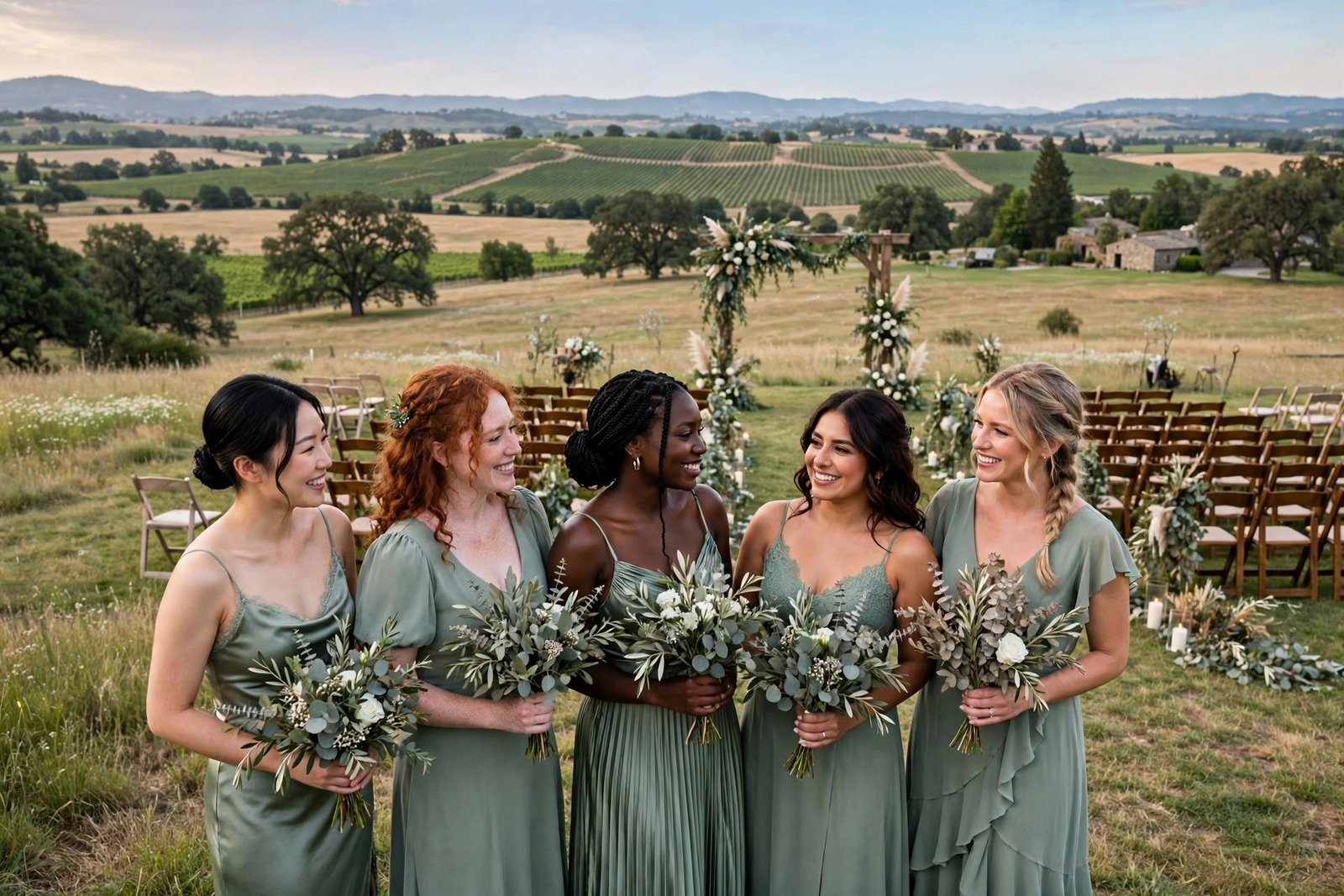
Winter weddings suit elegant, structured styling. A long-sleeved dress, a heavier crepe or velvet fabric, closed shoes and a tailored coat create a refined winter look that still flatters a petite frame, provided the coat is cropped or neatly fitted rather than long and bulky. If you are also thinking about wedding party colours, our guide to sage green bridesmaid dresses shows how a muted, versatile shade can be styled across seasons, and the same seasonal thinking applies to guest dresses.

Shoes, Accessories and Outerwear
Shoes change the whole proportion of a wedding guest outfit, so choose them before finalising the hem. Block heels are a practical favourite for petite guests, offering height and stability on grass, gravel and uneven floors, while elegant heels suit indoor venues and formal evenings. Embellished flats can be just as dressy as heels when paired with a well-chosen hem, and they are a kind choice for a long day of standing and dancing.
A shoe in a tone close to your skin tone, or close to the dress colour, lengthens the leg visually, which is a helpful trick for petite frames. Pointed or almond-shaped toes also extend the line of the leg more than a very round toe, though comfort must come first. Whatever you choose, test the hem with those exact shoes, not with a different pair, since even a small change in heel height alters where the dress falls.
Accessories should stay in scale. A small clutch, delicate jewellery and one statement piece, such as striking earrings or a beautiful hair accessory, usually look more polished than several large pieces competing for attention. A hat or fascinator can be a lovely finishing touch for a formal wedding, but keep it in proportion to your frame and check that it does not hide your face in photographs.
Outerwear deserves the same attention as the dress. A cropped jacket, a neat bolero or a tailored coat that finishes at the waist or hip preserves the dress proportions, while a long, heavy coat can hide the silhouette entirely. A pashmina or wrap is a flexible alternative, offering warmth for the evening without covering the dress shape, and it photographs softly draped over the shoulders.

Fitting, Alterations and Comfort
Even a beautiful dress benefits from a good fitting. Book alterations with enough time for a second fitting, and take the shoes and underwear you plan to wear, since both change how the dress sits. A good alteration can raise a waistline, shorten a strap, narrow a shoulder or adjust a hem, but it cannot easily rebuild a bodice that is fundamentally the wrong shape, which is why starting with the right silhouette matters so much.
Check the practical details before the day. Make sure the dress has enough lining to avoid transparency under bright light or photographs, that fastenings sit flat and secure, and that you can sit, walk and dance without the dress riding up or pulling. If the dress needs a particular type of underwear for support or smoothness, try that combination in advance rather than discovering a problem on the morning of the wedding.
Comfort is not a compromise on style; it is part of it. A petite guest who feels at ease in her dress stands taller, moves more naturally and enjoys the celebration more, and that confidence shows in every photograph. Choose fabrics that breathe, a fit that moves with you, and shoes you can genuinely wear all day, and the outfit will look after itself.
Common Mistakes to Avoid
- Choosing a standard dress and only shortening the hem: The waist, bodice and shoulders may still sit in the wrong places, so check the whole fit, not just the length.
- Picking a hem that cuts across the widest part of the calf: Try the dress with your chosen shoes and look for a hem that finishes at a slimmer point on the leg.
- Overloading the outfit with statement details: One beautiful detail usually looks more polished on a petite frame than several competing ones.
- Forgetting the venue and the ground underfoot: Block heels suit grass and uneven surfaces, while slim heels suit smooth indoor floors.
- Leaving alterations too late: Allow time for delivery, a first fitting and a second fitting before the wedding.
- Choosing a coat that hides the dress: A cropped or neatly tailored layer preserves the proportions you chose so carefully.
Frequently Asked Questions
What length is most flattering for petite wedding guests?
Knee-length and midi dresses are usually the most flattering, because they show the leg and keep the proportions balanced. A midi that finishes at a slim point on the lower leg, with a defined waist, works particularly well, while a long dress can also look elegant in a flowing fabric with a continuous line.
Should petite guests wear heels to a wedding?
Heels are not essential, but they do change the proportion of an outfit. Block heels offer height with stability, elegant heels suit formal venues, and embellished flats can be just as dressy. Choose what you can wear comfortably all day, and finalise the hem with those exact shoes.
Do petite wedding guest dresses need to be from a petite range?
Not always, but a petite range is a helpful starting point because the bodice, waist and shoulders are cut for a smaller frame. A standard dress can work with thoughtful alterations, especially if the silhouette is simple and the fabric is easy to adjust.
What colours suit petite wedding guests?
Any colour can suit a petite guest, but a single colour from neckline to hem creates a long, unified line. Soft pastels suit spring and summer, deeper tones suit autumn and winter, and jewel tones work across seasons. Keep accessories calm if the dress colour is bold.
Conclusion
The best petite wedding guest dresses are not about following a rigid set of rules; they are about proportion, fit and confidence. Choose a length that flatters your leg, a silhouette that defines your waist without overwhelming your frame, and details that stay in scale. Style it for the season and the venue, choose shoes you can wear all day, and finish with outerwear that preserves the shape you have created. Done that way, a petite wedding guest dress does exactly what occasion wear should do: it lets you look elegant, feel comfortable, and enjoy every moment of the celebration.